
The University of Zambia through its School of Education and in collaboration with international research institutions continues to play a leading role in advancing Education for Sustainable Development (ESD) across Sub-Saharan Africa. One of the strategic partnerships is being done through the implementation of the Sub-Saharan Africa Teacher Leadership for Education for Sustainable Development Project (SSATL-ESD). The SSATL-ESD project brings together a diverse network of higher education institutions and sustainability partners from both Europe and Africa, creating a strong platform for collaboration, knowledge exchange, and innovation in Education for Sustainable Development. In Europe, the project is coordinated by Leuphana University in Germany, working alongside Heidelberg University of Education. Greece is represented by the University of Crete together with the Regional Centre of Expertise (RCE) Crete, while Cyprus contributes through Frederick University. Across sub-Saharan Africa, the partnership extends to South Africa through Rhodes University and University of the Witwatersrand. Namibia participates through the University of Namibia and Namibia University of Science and Technology, while Zambia is represented by the University of Zambia and Copperbelt University. In Malawi, the collaboration includes the University of Malawi and the Catholic University of Malawi. Kenya’s contribution comes from Jomo Kenyatta University of Agriculture and Technology and Kenyatta University. Together, these institutions form a transcontinental consortium committed to advancing sustainable development through research, innovation, capacity building, and transformative higher education initiatives for teacher leaders in ESD. The initiative, which commenced in November 2024 and runs until October 2027, seeks to strengthen the capacity of teacher educators to provide transformative leadership in Education for Sustainable Development.
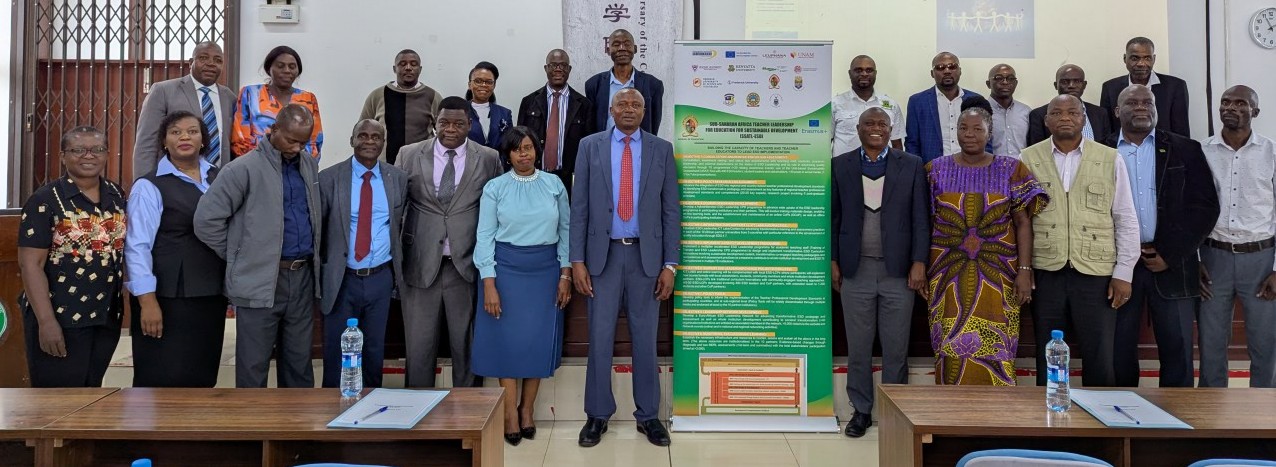
Photo: Stakeholder engagement meeting with TEIs administrators, March 2025
The project is part of a wider international collaboration involving African and European universities committed to improving teacher education systems and promoting sustainable development through education. The initiative aligns with the growing recognition of the SDG 4.7, AU Teacher Competence Framework, and Agenda 2030. As one of the key institutions in the consortium, the University of Zambia has successfully undertaken several milestone activities under the project, including key stakeholder engagement, a regional baseline study that examined the current status of ESD leadership and practice across participating institutions in South Africa, Namibia, Kenya, Malawi, and Zambia. The study revealed that while many institutions have made progress in integrating sustainability into teacher education, ESD leadership practices remain fragmented and often disconnected across disciplines. These findings have highlighted the urgent need for stronger interdisciplinary collaboration and coordinated institutional approaches to sustainability education leadership. Another major milestone achieved by the School of Education at UNZA has been the establishment of a modern ICT laboratory dedicated to supporting ESD scholarship, research, and academic collaboration.
The ICT lab has significantly improved access to reliable internet connectivity and digital learning infrastructure for both staff and students. The facility has become an important academic hub within the School of Education, hosting bi-weekly academic seminars that promote scholarly engagement among master’s and PhD students. In addition, students utilize the laboratory for research activities, collaborative learning, networking, and peer review sessions that encourage critical academic feedback and innovation. Under the ongoing project activities, the University of Zambia is spearheading a Teacher leader CPD aimed at training teacher educators from various colleges and universities across Zambia. Participating institutions include Mulungushi University (13), Kwame Nkrumah University (13), Chalimbana University (13), Mongu College of Education (13), Charles Lwanga College of Education (13) in ESD Leadership. The training is expected to run between May and September 2026. The programme targets the training of at least 40 teacher educators in Zambia who are expected to transfer their acquired knowledge and skills to pre-service teachers through ESD Change Projects and innovative teaching approaches. Through this cascading model, the project is expected to contribute to the mainstreaming of Education for Sustainable Development within Zambia’s competence-based curriculum framework of 2023, where it is recognised as a cross-cutting issue.
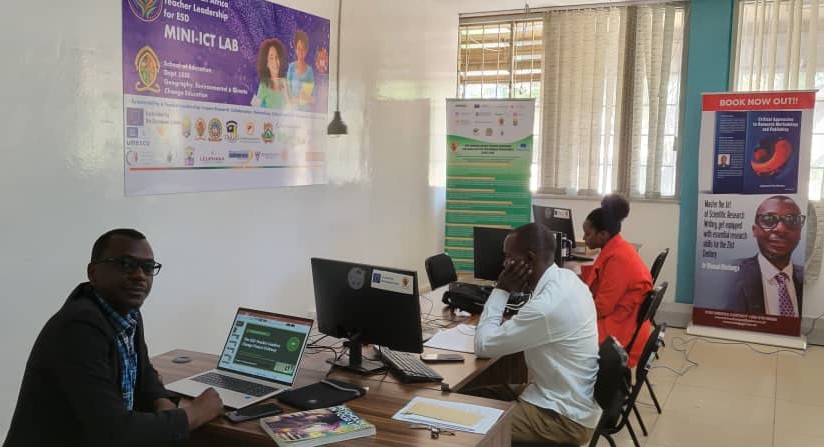
Photo: Inside the Project-funded Mini-ICT Lab for ESD Leadership during the Teacher Leader CPD Course Inception Meeting, School of Education UNZA
During the inception meeting for the Teacher Leader CPD on 26th May 2026, Dr. Manoah Muchanga, the Principal Lead of the Project at the University of Zambia said that, “this intervention is a low-hanging fruit for implementation of Education for Sustainable Development as a cross-cutting issue in the 2023 Education Curriculum Framework”. Dr. Liberty Mweemba, the Dean of the School that hosts the project further added that, “as teacher educators we have to be first agents and advocates of change, we cannot change others if we are not first willing to change ourselves for sustainability. This teacher leader CPD comes at a very crucial time when the country needs teacher leadership and agency for ESD”. The University of Zambia’s continued participation in this international collaboration demonstrates the institution’s commitment to academic service and excellence, sustainability, and regional leadership in teacher education transformation. Through partnerships, research, and capacity building, the School of Education remains at the forefront of advancing Education for Sustainable Development for the benefit of present and future generations.
For more information about the project, visit https://lead4esd.net/
Should you have any further questions, please write to the project lead at the University of Zambia.
Names: Dr. Manoah Muchanga.
Email: mmuchanga@unza.ac.zm.
A PDF version of the article you have just read can be downloaded as indicated below: